By Dianne Sindayen ✔ Reviewed by travel expert Ben Braude
Vienna is one of the few European capitals where six centuries of Habsburg rule are still written into the skyline.
The historic center, inscribed on the UNESCO World Heritage list in 2001, holds the imperial palaces, opera houses, and Gothic spires that defined Central Europe's cultural capital.

Nine of the most famous landmarks in Vienna are covered below, from the 12th-century St. Stephen's Cathedral and the 1,441-room Schönbrunn Palace to the 1897 Riesenrad and the baroque masterpiece of Karlskirche.
Planning a trip to Vienna is easier than most people expect. Great Value Vacations offers curated Vienna travel packages that take care of the details so you can focus on the experience.
Why Vienna's Landmarks Define the Heart of Central Europe
A few reasons the city's landmarks are worth the trip:
- Six centuries of Habsburg rule: The dynasty governed from Vienna from 1273 to 1918, and their palaces, churches, and civic buildings still set the skyline.
- UNESCO-listed historic center: Vienna's inner city and Schönbrunn Palace and Gardens both hold UNESCO World Heritage status, inscribed in 2001 and 1996 respectively.
- The Ringstrasse pulls it together: The grand 19th-century boulevard loops the old town and connects the Parliament, the Rathaus, the Opera, and the museums in a single walkable circuit.
- Music capital with the receipts: Mozart, Beethoven, Schubert, Strauss, Mahler, and Brahms all lived and worked here. The Staatsoper still performs around 350 nights a year.
- Compact and walkable: Most of the inner-city landmarks sit within a 20-minute walk of Stephansplatz, so a solid landmark itinerary fits into 3 days.
Vienna Landmarks at a Glance
An at-a-glance look at how the nine landmarks fit your trip:
| Landmark | Era | Best for | Cost |
|---|---|---|---|
| St. Stephen's Cathedral | 12th to 15th c. | Gothic architecture, city views | $ |
| Schönbrunn Palace | 17th to 18th c. | Half-day visits, gardens | $$ |
| Hofburg Palace | 13th to 19th c. | Imperial history, museums | $$ |
| Belvedere Palace | 18th c. | Klimt and baroque art | $$ |
| Vienna State Opera | 19th c. | Performances, tours | $ to $$$ |
| Karlskirche | 18th c. | Baroque, dome elevator | $ |
| Wiener Riesenrad | 19th c. | Skyline views, families | $ |
| Austrian Parliament | 19th c. | Architecture, Pallas Athena | Free outside |
| Vienna City Hall | 19th c. | Neo-Gothic, year-round events | Free outside |
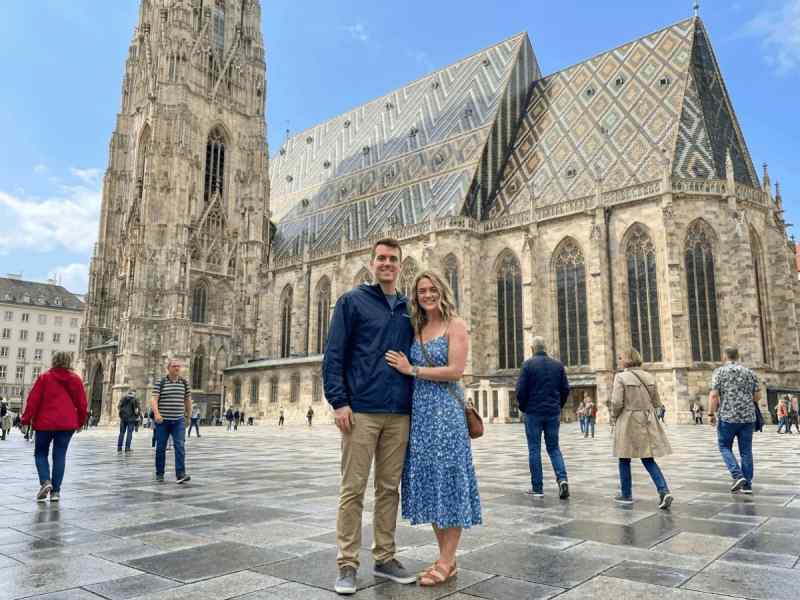
1. St. Stephen's Cathedral (Stephansdom)
St. Stephen's Cathedral (Stephansdom), with origins in 1137 and its current Gothic form largely completed in 1511, is the symbolic heart of Vienna. The cathedral's south tower (Steffl) rises 136.4 meters, making it one of the tallest churches in Europe. Its multicolored tile roof, laid with 230,957 glazed tiles in geometric patterns, is one of the most photographed details in the city.
What Makes It Iconic: It is the spiritual and geographic center of Vienna. Mozart was married here in 1782 and his funeral service was held here in 1791. The roof tiles form the Habsburg double-headed eagle on one side and the Vienna and Austrian coats of arms on the other. Standing under the south tower and looking up at the tile roof, the Habsburg double-headed eagle only becomes visible once someone points it out. After that you cannot stop seeing it.
While You're Here: Climb the 343 steps of the south tower for one of the best views of the inner city. The catacombs tour beneath the cathedral covers ducal crypts and the remains of more than 11,000 Viennese. The cathedral interior is free to enter. The tower climb and catacombs are ticketed separately. If time is short, the interior and roof tiles from the outside are enough for a meaningful visit.
Find It Here: Stephansplatz 3, 1010 Vienna.
How to Get There: Take U-Bahn line U1 or U3 directly to Stephansplatz station. The cathedral entrance is at the top of the escalator.

2. Schönbrunn Palace
Schönbrunn Palace, the Habsburg summer residence, was largely shaped between 1696 and 1780 under emperors Leopold I and Maria Theresa. The 1,441-room baroque palace and its formal gardens cover 160 hectares and have been on the UNESCO World Heritage list since 1996. Emperor Franz Joseph was born here in 1830 and died here in 1916, ending nearly 68 years of Habsburg rule from the palace.
What Makes It Iconic: It is Austria's most visited cultural site and the standard against which other European royal palaces are measured. The Gloriette hill behind the palace offers the postcard view back across the gardens to the building itself. The view from the Gloriette looking back down at the palace and the city beyond it is the one photograph that makes Vienna look exactly as imperial as it actually was.
While You're Here: Walk up to the Gloriette for the panoramic view, then loop through the Privy Garden, the Palm House, and the world's oldest continuously operating zoo (Tiergarten Schönbrunn, founded in 1752). The palace interior requires a ticket. The gardens and Gloriette walk are free and worth at least 90 minutes on their own.
Find It Here: Schloss Schönbrunn, Schoenbrunner Schlossstrasse 47, 1130 Vienna.
How to Get There: Take U-Bahn line U4 to Schönbrunn station. From the inner city it is about 15 minutes by metro.

3. Hofburg Palace
The Hofburg served as the principal winter residence of the Habsburg dynasty from the 13th century until 1918. The complex grew across more than 700 years and today covers around 240,000 square meters with 18 wings, 19 courtyards, and 2,600 rooms. The Austrian president now keeps an office in the Leopoldine Wing, which makes the Hofburg one of the few former imperial palaces still used as a working seat of government.
What Makes It Iconic: Six centuries of imperial decisions, treaties, and ceremonies happened inside these walls. The complex also houses the Imperial Apartments, the Sisi Museum, the Imperial Silver Collection, the Austrian National Library, and the Spanish Riding School. The Hofburg is so large that most visitors only ever see one corner of it. That corner alone takes most of a day.
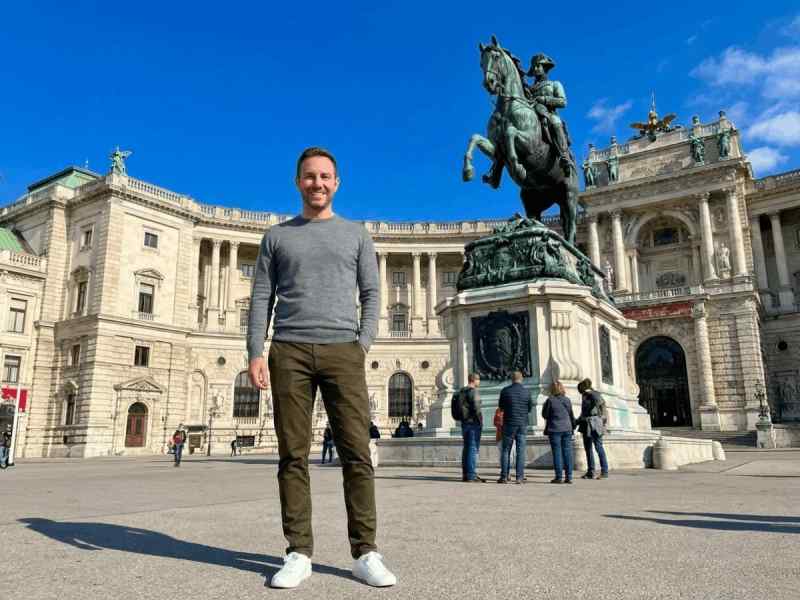
While You're Here: Cross Heldenplatz (Heroes' Square) to see the equestrian statues of Prince Eugene of Savoy and Archduke Charles, then walk through Michaelerplatz to view the Roman ruins beneath the square. The exterior courtyards and Heldenplatz are free. The Imperial Apartments, Sisi Museum, and Silver Collection require a combined ticket. Pick one or two interior stops rather than trying to cover everything in a single visit.
Find It Here: Michaelerkuppel, 1010 Vienna, just west of Stephansplatz.
How to Get There: Take U-Bahn line U3 to Herrengasse, then walk 3 minutes south to Michaelerplatz.
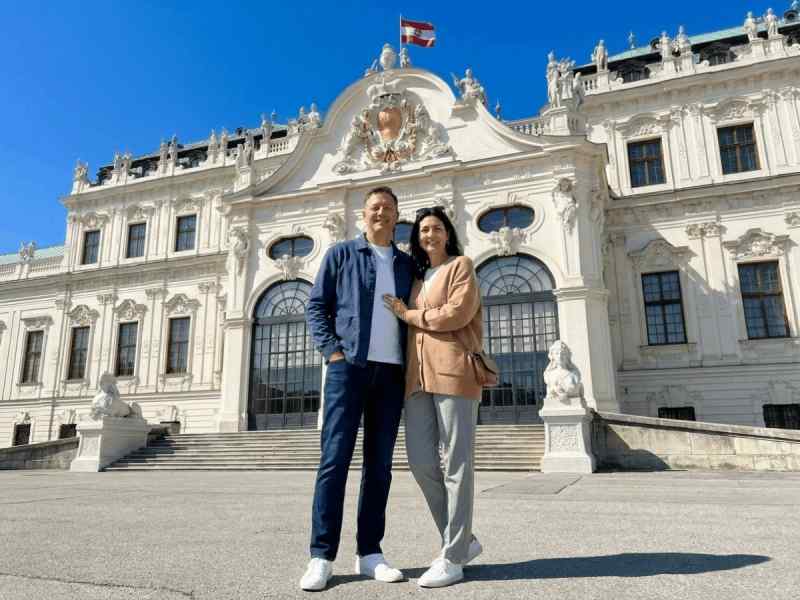
4. Belvedere Palace
The Belvedere is two baroque palaces, Upper and Lower Belvedere, built between 1714 and 1723 by architect Johann Lukas von Hildebrandt as the summer residence of Prince Eugene of Savoy. Today the complex houses the world's largest collection of Gustav Klimt paintings, including his most famous work, The Kiss (1907 to 1908). The Belvedere also holds the Austrian State Treaty, signed here in 1955 to restore Austria's independence after World War II.
What Makes It Iconic: It is one of the finest examples of secular baroque architecture in Europe and the home of Klimt's most recognized painting. The formal gardens between the two palaces frame a textbook view of the inner city skyline. Standing in front of The Kiss in person the gold leaf does something that no reproduction manages. Most people go quiet for a few seconds before they realize they have.
While You're Here: Take the slow walk from Upper to Lower Belvedere through the cascading fountains and sphinx statues. Pause at the upper terrace for the photograph that captures Vienna's church spires behind the lower palace. The Upper Belvedere is the priority. The Lower Belvedere and Orangery are worth adding on a second visit or if you have a full afternoon.
Find It Here: Prinz-Eugen-Strasse 27, 1030 Vienna.
How to Get There: Take tram D to Schloss Belvedere, or U-Bahn line U1 to Hauptbahnhof and walk 10 minutes north.
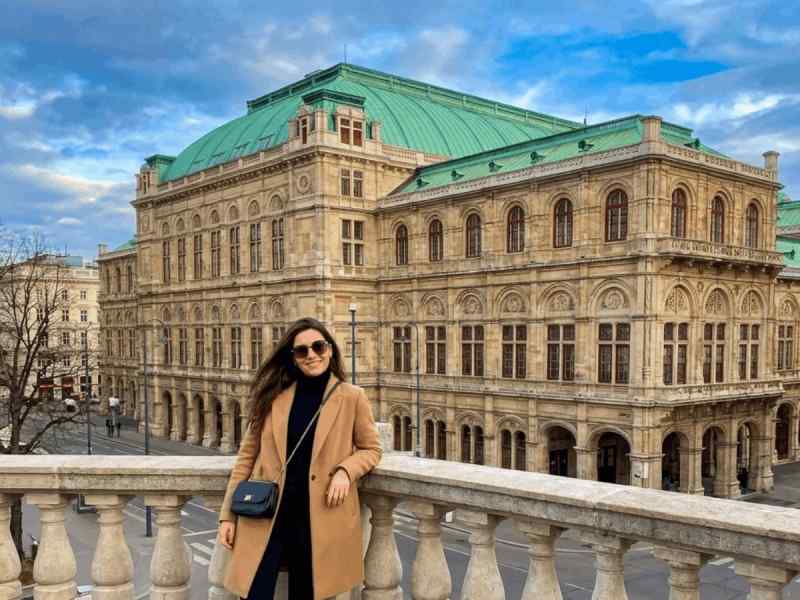
5. Vienna State Opera (Wiener Staatsoper)
The Vienna State Opera opened on May 25, 1869 with a performance of Mozart's Don Giovanni. The neo-Renaissance opera house stages around 350 performances a season across 60 different productions, more than almost any other opera house in the world. It is also the venue for the annual Vienna Opera Ball, traditionally held on the Thursday before Ash Wednesday.
What Makes It Iconic: It is the resident company of one of the great opera capitals, and one of the few houses where you can hear a different program almost every night of the season. The building was heavily damaged in 1945 and rebuilt in time for a 1955 reopening with Beethoven's Fidelio. Standing through a Mozart opera at the Staatsoper with the Vienna Philharmonic in the pit for €15 is one of the best value cultural experiences in Europe.
While You're Here: Buy a standing-room ticket (Stehplatz) on the day of the performance at the Operngasse entrance, or take a 40-minute guided building tour to see the rebuilt foyer, the imperial tea room, and the side stages. If attending a full performance is not possible, the building tour is a worthy alternative. The exterior on the Ringstrasse is free and worth five minutes on its own.
Find It Here: Opernring 2, 1010 Vienna.
How to Get There: Take U-Bahn lines U1, U2, or U4 to Karlsplatz, or tram 1, 2, 71, or D to Oper. The entrance is on the Ringstrasse.
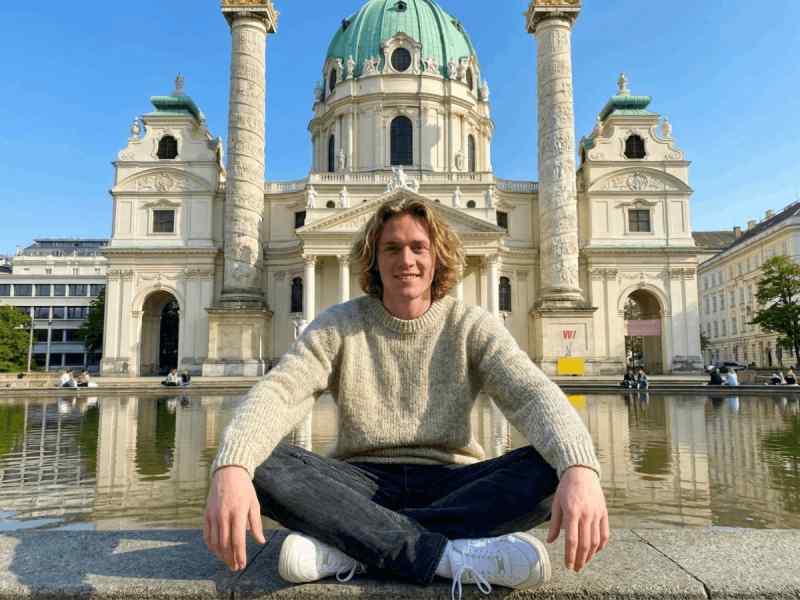
6. Karlskirche
Karlskirche (St. Charles's Church), built between 1716 and 1737, is widely considered the most important baroque church north of the Alps. Emperor Charles VI commissioned it in fulfillment of a vow made during the 1713 Vienna plague, dedicated to his namesake Saint Charles Borromeo. Architect Johann Bernhard Fischer von Erlach combined a Greek portico, a Roman dome, and two Trajan-style columns into a single facade that almost shouldn't work but does.
What Makes It Iconic: The two flanking columns are unique among European churches and tell the life of Saint Charles Borromeo in carved relief. The frescoes inside the 72-meter dome were painted by Johann Michael Rottmayr between 1725 and 1730. The reflecting pool in front of the church was added in 2004 and is not original but it doubles the facade in still water on calm days and makes the whole thing look even more improbable than it already is.
While You're Here: Ride the panoramic lift up to the dome's viewing platform for a close look at Rottmayr's frescoes and a roof-level view across the church's reflecting pool toward the Ringstrasse. The dome lift is the main reason to buy a ticket. The church exterior and reflecting pool are free and one of the best free photo spots on the Ringstrasse.
Find It Here: Kreuzherrengasse 1, 1040 Vienna, on Karlsplatz.
How to Get There: Take U-Bahn lines U1, U2, or U4 to Karlsplatz. The church is a 3-minute walk from the station exit.

7. Wiener Riesenrad at Prater
The Wiener Riesenrad (Vienna Giant Ferris Wheel), built in 1897 to mark the Golden Jubilee of Emperor Franz Joseph, is one of the oldest Ferris wheels still in operation. The 64.75-meter wheel originally had 30 wooden gondolas, of which 15 remain after damage during World War II. It became a global icon in the 1949 film The Third Man, when Orson Welles and Joseph Cotten ride a single gondola during one of cinema's most quoted scenes.
What Makes It Iconic: It is the symbol of the Prater amusement park and a Viennese skyline marker visible from across the city. A full rotation takes about 15 minutes and runs year-round. The gondola is larger and slower than you expect. When it stops at the top and the city spreads out below you in every direction, the 15-minute ride suddenly feels like the right amount of time.
While You're Here: Walk into the rest of the Prater after your ride. The 6-kilometer Hauptallee tree-lined avenue cuts through the green parkland and is a favorite Sunday stroll for locals. If the queue is longer than 20 minutes, the view from the Prater park on foot is nearly as good and completely free.
Find It Here: Riesenradplatz 1, 1020 Vienna.
How to Get There: Take U-Bahn lines U1 or U2 to Praterstern. The wheel is a 4-minute walk from the station exit.
8. Austrian Parliament Building
The Austrian Parliament Building, completed in 1883 by architect Theophil Hansen, is one of the most striking Greek Revival buildings in Europe. Hansen designed it to evoke ancient Athens as the birthplace of democracy, complete with eight Corinthian columns at the entrance and a 5.5-meter bronze statue of Pallas Athena (the Greek goddess of wisdom) on the fountain out front. The building underwent a complete 5-year renovation that wrapped up in 2023.
What Makes It Iconic: It is the home of Austria's National Council and Federal Council, and one of the most-photographed sections of the Ringstrasse. The Pallas Athena fountain has become an unofficial symbol of Austrian democracy and one of the most photographed details on the Ringstrasse. Almost nobody knows her name when they are standing in front of her.
While You're Here: Free guided tours of the historic chambers run on most weekdays when parliament is not in session. The visitor center and rooftop terrace are open to the public, and the rooftop offers a fresh angle on the Ringstrasse. The Pallas Athena fountain and the facade are worth five minutes from outside even if you skip the interior tour.
Find It Here: Dr.-Karl-Renner-Ring 3, 1017 Vienna.
How to Get There: Take U-Bahn line U3 to Volkstheater, or tram 1, 2, 71, or D to Stadiongasse/Parlament.

9. Vienna City Hall (Rathaus)
The Vienna City Hall (Rathaus), completed in 1883 by Friedrich von Schmidt, is one of the most ambitious neo-Gothic buildings of the 19th century. The 98-meter main tower is topped by the Rathausmann, a 3.4-meter copper knight that has become one of Vienna's mascots. Rathausplatz, the square in front, runs back-to-back festivals throughout the year, including the Vienna Christmas Market, the open-air Film Festival in summer, and an enormous ice-skating rink each winter.
What Makes It Iconic: It is the seat of Vienna's mayor and city government, and the social heart of the Ringstrasse. The wide square in front gives it the most generous setting of any landmark on the boulevard. Rathausplatz in front of the Rathaus runs a different event almost every month of the year. Whatever is happening there when you visit, it will feel like the city planned it specifically for your arrival.
While You're Here: Walk through the Arkadenhof, the inner arcaded courtyard, for one of the most underrated photo spots in the inner city. Check the Rathausplatz event schedule before you visit, because the square almost always has something running. The Rathaus is best experienced from the square rather than inside, and it pairs naturally with our list of free things to do in Vienna if you're stretching the budget. The interior guided tours are worth it only if you have a specific interest in Viennese civic architecture.
Find It Here: Friedrich-Schmidt-Platz 1, 1010 Vienna.
How to Get There: Take U-Bahn line U2 to Rathaus, or tram 1, 71, or D to Rathausplatz/Burgtheater.
Plan Your Vienna Landmark Itinerary
Vienna rewards a slow trip. Three or four days inside the Ringstrasse, an afternoon at Schönbrunn, and an evening at the Staatsoper add up to a city break that feels both grand and unhurried. If you're still unsure if Vienna is right for you, check out our Vienna travel guide to learn more about this iconic destination.
Planning a trip to Vienna is easier than most people expect. Great Value Vacations offers curated Vienna travel packages that take care of the details so you can focus on the experience.
VIEW VACATION PACKAGES TO VIENNA