By Dianne Sindayen ✔ Reviewed by travel expert Ben Braude
Hungarian food gets flattened into "goulash" by most first-time visitors, but truthfully, the real range is wider and stranger than that.

Start with three dishes: gulyás (a slow-simmered beef and paprika soup, not the thick stew Americans picture), csirkepaprikás (chicken in a creamy paprika sauce, almost always with soft egg dumplings), and lángos (fried dough topped with sour cream and cheese, sold hot off market stalls). None of it is spicy. All of it is built on sweet paprika, sour cream, and meat cooked low and slow until it falls apart.
The rest of this list breaks down what each dish actually tastes like, what locals order versus what gets served to tour groups, and where in Budapest to find the version that's worth ordering.
Eating your way through Budapest is easier with the logistics handled. Great Value Vacations offers curated Hungary vacation packages built around exactly this kind of trip.
Why Hungarian Food Tastes Different from Anything Else in Europe
A few reasons Budapest's traditional cuisine deserves its reputation:
- Paprika is the cornerstone: Hungary's paprika is grown mainly around Szeged and Kalocsa, the two towns most associated with the spice, and it colors nearly every traditional dish on this list.
- Sour cream and lard, not olive oil: Traditional Hungarian cooking leans on sour cream (tejföl), pork lard, and butter rather than olive oil. This is what gives even simple dishes their distinctive richness.
- Magyar herding roots: Goulash and pörkölt both trace to medieval Hungarian cattle herders who cooked thick paprika stews in open kettles (bogrács) on the Great Plain. The kettle is still a national symbol.
- Cross-cultural influences without losing character: Hungarian cuisine borrowed from Ottoman (paprika itself, stuffed cabbage), Habsburg (strudels, schnitzels, layer cakes), and Jewish (sólet, flódni) traditions, then made each its own.
- Affordable across the board: A traditional Hungarian sit-down meal in Budapest runs 4,500 to 8,000 HUF (11 to 20 euros), including a glass of wine or beer. Markets and stalls drop that to 1,500 to 3,000 HUF.
Traditional Budapest Foods at a Glance
A quick read on how the nine dishes fit your trip:
| Dish | Category | What It Is | Typical Cost |
|---|---|---|---|
| Gulyás | Soup / main | Beef and paprika stew-soup | $ |
| Csirkepaprikás | Main | Chicken in sour cream-paprika sauce | $ |
| Halászlé | Soup | Spicy river fish soup | $ |
| Lángos | Street food | Deep-fried flatbread, toppings | $ |
| Töltött Káposzta | Main | Stuffed cabbage with paprika | $ |
| Hortobágyi Palacsinta | Starter | Savory crepe with meat filling | $ |
| Pörkölt | Main | Dry Hungarian stew, sour cream | $$ |
| Dobos Torta | Dessert | Layered cake with caramel top | $ |
| Kürtőskalács | Street food | Spit-roasted sweet pastry | $ |

1. Gulyás (Beef Goulash Soup)
Gulyás (pronounced "GOO-yash") is Hungary's national dish and the only dish on most Hungarians' "if I had to name one" list. The traditional version is a soup, not a stew, with beef, onions, potatoes, carrots, paprika, and caraway, slowly cooked in a cast-iron bogrács kettle over an open fire. The dish dates to medieval Hungarian cattle herders (gulyás means "herdsman") who needed a portable, calorie-dense meal that could be made from one pot on the Great Plain.
What It Tastes Like: Deep beefy broth, sweet paprika-onion base, and chunks of tender slow-cooked beef. The caraway adds a slightly anise warmth, and a swirl of sour cream at the end softens the paprika edge.
What to Pair It With: A glass of Hungarian dry red, ideally Egri Bikavér ("Bull's Blood of Eger"), or a Hungarian pilsner like Soproni. A side of csipetke (small hand-pinched egg noodles) is the traditional add-in.
Good to Know: What Americans call "goulash" (a thick beef-and-tomato stew over noodles) is not Hungarian gulyás. The Hungarian version is brothy, has no tomato, and is served as a starter or light main. Order "gulyásleves" if you want to be precise.

2. Csirkepaprikás (Chicken Paprikash)
Csirkepaprikás (pronounced "CHEER-keh-pap-ree-kash") is the Hungarian dish most often served at family Sunday lunches. Bone-in chicken is browned in pork lard, then simmered with onions, sweet paprika, and a generous spoonful of sour cream at the end to make the signature orange-red sauce. The dish is almost always paired with nokedli, the small egg dumplings that look like spaetzle but eat softer.
What It Tastes Like: Smoky-sweet from the paprika, rich and creamy from the sour cream finish, with deep umami from the slow-cooked chicken bones. The nokedli soak up the sauce and become the best part of the plate.
What to Pair It With: A glass of Olaszrizling (Hungarian Welschriesling, slightly off-dry) or a Hárslevelű from the Tokaj region. The acidity of the white wine cuts the creamy paprika sauce.
Good to Know: Real Hungarian paprikash uses bone-in chicken thighs and drumsticks, not boneless breast. If you see boneless chicken paprikash on a menu, the restaurant is probably catering to tourists and using a shortcut version.
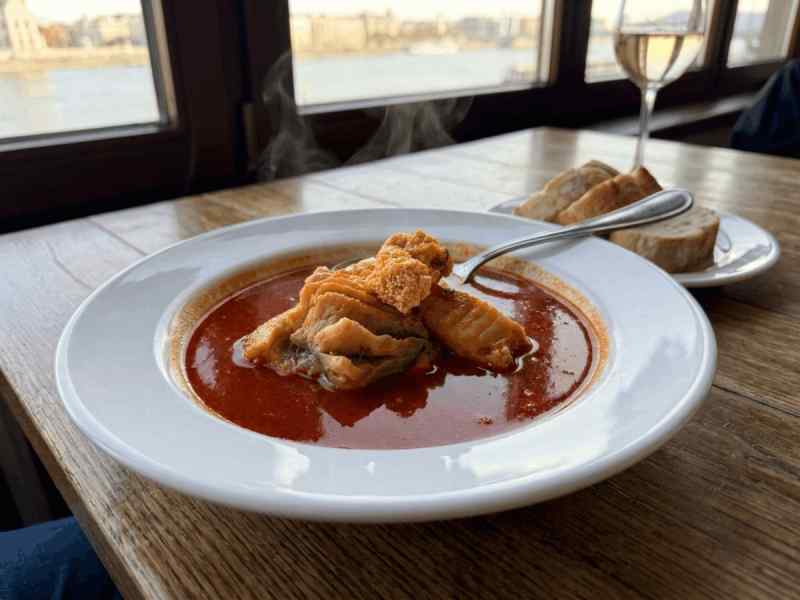
3. Halászlé (Fisherman's Soup)
Halászlé (pronounced "HOLL-aas-lay") is Hungary's second most-famous soup after gulyás, and the more fiery of the two. The base is made from carp and catfish (and sometimes pike) slowly cooked with onions, sweet paprika, and hot paprika until the broth turns brick red. Traditionally cooked in a kettle on the banks of the Tisza or Danube rivers, modern Budapest versions are made indoors but still served in a small cast-iron pot or bowl. The two rival styles, Baja on the Danube and Szeged on the Tisza, have been arguing about the correct version for well over a century.
What It Tastes Like: Spicy, paprika-deep, slightly sweet from the onions, and rich with carp flavor. The dried Bogyiszló hot paprika gives it real kick, which is rare for Hungarian food and the reason halászlé stands out.
What to Pair It With: A light, slightly sweet white wine like a Furmint or Hárslevelű from Tokaj cuts the heat. Bread for soaking up the broth is standard; rice on the side is a Szeged-style add-on.
Good to Know: Halászlé season peaks December through February, especially around Christmas Eve, when many Hungarian families serve it as the first course of the holiday meal. Carp bones are small and numerous; eating it slowly is the local rhythm.
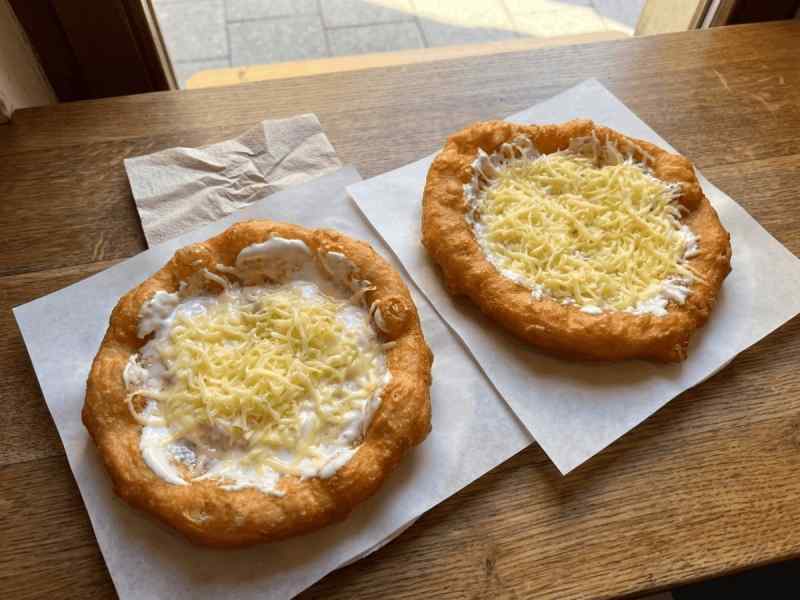
4. Lángos (Deep-Fried Flatbread)
Lángos (pronounced "LAHN-gosh") is Hungary's defining street food. The base is a deep-fried disk of yeasted dough, about 25 centimeters across, rubbed while hot with cut garlic and lightly salted. The traditional topping is sour cream and grated sheep's cheese (sajtos-tejfölös), though variations now run from ham-and-egg to Nutella. Lángos was originally a peasant breakfast (the name comes from "láng," meaning flame, because the dough was once baked on the inside wall of a wood-burning bread oven). The deep-fried version we know today didn't emerge until the early-to-mid 20th century, once home ovens replaced the old communal wood-fired kind.
What It Tastes Like: Crispy and crackling on the outside, soft and steamy inside, with the garlic rub hitting first. The classic sour cream and cheese version balances richness against the slight tang of the dough.
What to Pair It With: A cold Hungarian draft beer (Dreher or Soproni) or a small glass of pálinka (Hungarian fruit brandy) on the side. Lángos eats best within 5 minutes of frying, so plan your meal around proximity to a stall, not the other way around.
Good to Know: The best lángos in Budapest is at the Retró Lángos Büfé inside the Central Market Hall (Vámház körút 1) and at the open-air stalls in the Bosnyák tér market. Both fry to order. Lángos at touristy spots is often pre-fried and reheated.

5. Töltött Káposzta (Stuffed Cabbage)
Töltött Káposzta (pronounced "TUR-lurt KAA-pos-taw") is Hungary's Christmas Eve and New Year's Day dish, served in almost every traditional household across Central Europe. Cabbage leaves are blanched, then wrapped around a filling of ground pork, rice, onion, paprika, and a touch of marjoram. The rolls are simmered in a sauerkraut and tomato-paprika sauce for two to three hours, served with sour cream and (in northern Hungary) smoked sausage on top. The dish traces back to Ottoman-era stuffed vegetable cooking (sarma), reworked with Hungarian ingredients like pork, sauerkraut, and paprika into something distinctly local.
What It Tastes Like: Tangy from the sauerkraut and tomato base, deeply savory from the slow-cooked pork-rice filling, and a little smoky from the optional smoked sausage. The sour cream on top smooths the acidity.
What to Pair It With: A dry red wine, often Egri Bikavér or a Kékfrankos, holds up to the rich filling. A glass of Soproni Demon stout pairs nicely if you prefer beer.
Good to Know: Stuffed cabbage is always tastier on the second day, after the flavors settle. Hungarian families typically cook a giant pot on December 23 and eat it on Christmas Eve and Christmas Day. Many traditional restaurants serve "yesterday's töltött káposzta" as a feature.
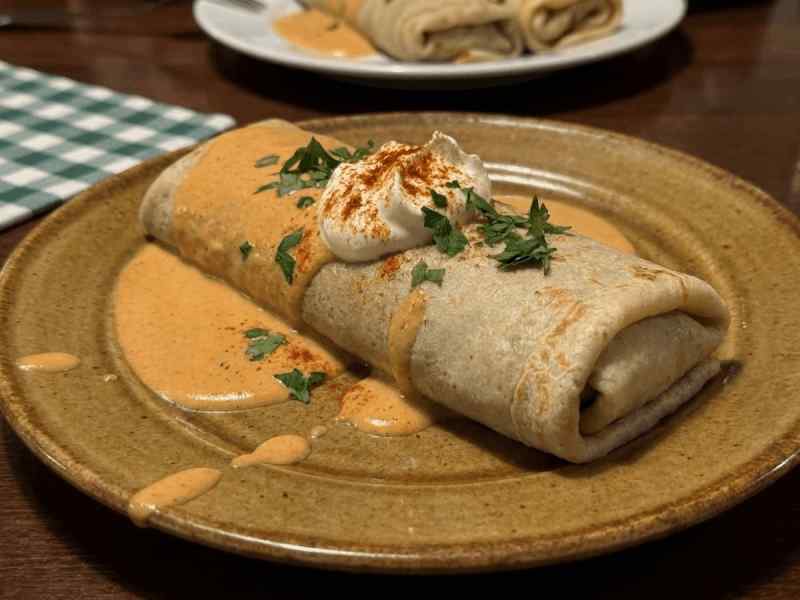
6. Hortobágyi Palacsinta (Savory Crepe)
Hortobágyi Palacsinta (pronounced "HOR-toh-baad-yee PAL-aw-cheen-taw") is one of the most photogenic Hungarian starters: thin egg crepes (palacsinta) filled with shredded slow-cooked veal in paprika and onion, then rolled and topped with a creamy paprika sour-cream sauce. Despite the name, it has nothing to do with the Hortobágy region or its herding traditions. The dish was invented in 1958 for Hungary's pavilion at the Brussels World's Fair, and "Hortobágyi" was chosen purely to sound rustic and regional to international visitors. It worked well enough that Hungarians themselves adopted it as a genuine classic within a decade.
What It Tastes Like: Buttery thin crepes wrap a slightly sweet paprika-veal filling. The top sauce is rich and creamy with a faint paprika kick, and the dish overall reads as a softer, more elegant gulyás.
What to Pair It With: A medium-bodied dry white wine like Cserszegi Fűszeres, or a glass of Hungarian dry rosé. The savory crepe is usually served as a starter ahead of a main like csirkepaprikás or pörkölt.
Good to Know: Real hortobágyi uses shredded veal cooked low for 3 to 4 hours; tourist versions sometimes substitute ground beef or chicken. The signature curl of paprika oil on top of the sauce is a tell that the kitchen is using real Hungarian sweet paprika, not generic chili powder.

7. Pörkölt (Hungarian Stew)
Pörkölt (pronounced "PURR-curlt") is gulyás's drier cousin: a slow-cooked stew of beef, veal, pork, or chicken, with no broth and a thick paprika-onion sauce. The Hungarian word means "roasted" or "singed," referring to the way the onions are first cooked dark in pork lard before the meat goes in. The result is a deeply caramelized, paprika-rich main course that is usually served over nokedli or rice. Pörkölt is the dish most often confused with goulash internationally.
What It Tastes Like: Deeply savory, paprika-forward, and slightly sweet from the caramelized onions. The meat is fall-apart tender after 3 hours of low cooking, and the sauce coats the nokedli without becoming soup.
What to Pair It With: A bigger Hungarian red like Egri Bikavér or a Kékfrankos handles the rich paprika sauce. For non-drinkers, a Hungarian Téli Saláta (winter pickle plate) on the side cuts through the richness.
Good to Know: The meat is always specified in the name: marhapörkölt is beef, sertéspörkölt is pork, csirkepörkölt is chicken, and borjúpörkölt is veal. Vadász- or szarvas-pörkölt is venison and is a winter specialty.
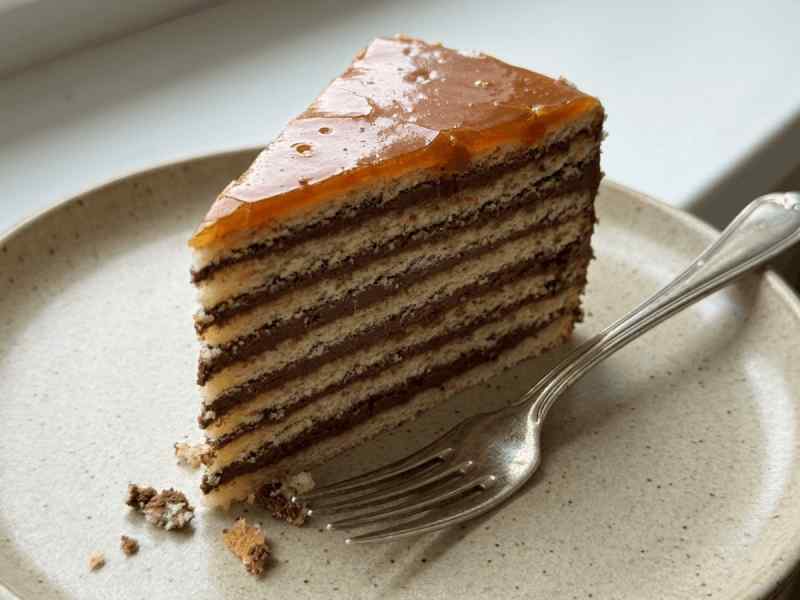
8. Dobos Torta (Caramel-Topped Layer Cake)
Dobos Torta (pronounced "DOH-bosh TOR-taw") is one of the most influential European cakes of the 19th century. Created in 1884 by Budapest confectioner József C. Dobos, the cake was unveiled the following year at the 1885 National General Exhibition in Budapest, where it was reportedly tasted by Emperor Franz Joseph and Empress Elisabeth.
The cake pairs thin layers of vanilla sponge with chocolate buttercream, topped with a hard caramel sheet sliced into triangular wedges. Sources differ on the exact original layer count, with most citing somewhere between five and seven sponge layers. Dobos kept the recipe secret for 21 years and reportedly traveled across Europe with the cake in a special wooden case to keep it intact in trains. He published the recipe in 1906 after retiring.
What It Tastes Like: Lightly bitter dark chocolate buttercream against fluffy vanilla sponge, with the caramel top adding a crackling sweet crunch and a slightly burnt-sugar edge. The cake is rich but not heavy thanks to the thin sponge layers.
What to Pair It With: A small glass of Tokaji Aszú (Hungary's legendary sweet wine) or a single espresso. The cake is traditionally served as an afternoon coffeehouse pastry, not as a post-dinner dessert.
Good to Know: No matter the exact layer count, authentic Dobos torta always has the signature caramel disk on top, sliced into triangular wedges, not a chocolate ganache cover. Gerbeaud Café (1858) on Vörösmarty tér is one of several historic Budapest coffeehouses still known for making it close to the original recipe.

9. Kürtőskalács (Chimney Cake)
Kürtőskalács (pronounced "KOOR-turshk-aw-lach"), or chimney cake, is Hungary's most photogenic street food. A spiral of sweet yeasted dough is wrapped around a wooden spit, rolled in sugar, and slowly turned over an open charcoal flame until the sugar caramelizes into a crackling golden crust. The cake is then pulled off the spit and finished with cinnamon, walnut, cocoa, or vanilla coating. The original recipe is from the 18th-century Transylvanian Hungarian Székely community, but Budapest has been the dish's commercial epicenter since the 2010s.
What It Tastes Like: The exterior is crackling-sugar-crust crisp; the interior pulls apart in a soft, slightly sweet brioche-style spiral. The smoke from the charcoal adds a faint barbecue note to the caramelized sugar.
What to Pair It With: Cold milk, hot chocolate, or a light Tokaj Furmint dessert wine. Kürtőskalács is traditionally a winter Christmas market food, so look for it paired with hot mulled wine (forralt bor) in December.
Good to Know: A real kürtőskalács costs around 2,000 HUF (5 euros) and is baked to order in about 10 minutes; "ice cream kürtős" (filled with soft serve) is a tourist-market 2010s invention and is not traditional. The Vörösmarty tér Christmas market has the highest density of charcoal-baked stalls in the city.
Budapest, One Bite at a Time
The dishes on this list are easy to get wrong and worth getting right. A bowl of gulyás that's actually a soup, chicken paprikash with the bone still in, lángos fried to order instead of reheated, that's the difference between a meal you forget and one you're still thinking about back home. Three or four days is enough to work through most of this list without rushing any of it.
The hard part is picking which dish to chase first. Everything else is handled. Great Value Vacations' Hungary packages take care of the flights, the hotel, and the logistics, leaving you free to focus on the food.
VIEW BUDAPEST VACATION PACKAGES